

TGA - Thermal Gravimetric Analysis
Introduction and Principles of TGA
Thermal Gravimetric Analysis TGA is a method of thermal analysis achieved by increasing the temperature of a sample over time whilst plotting weight against temperature. TGA effectively monitors volatiles given off as well as material transformations where compounds degrade or form at different temperatures or compounds evaporate.
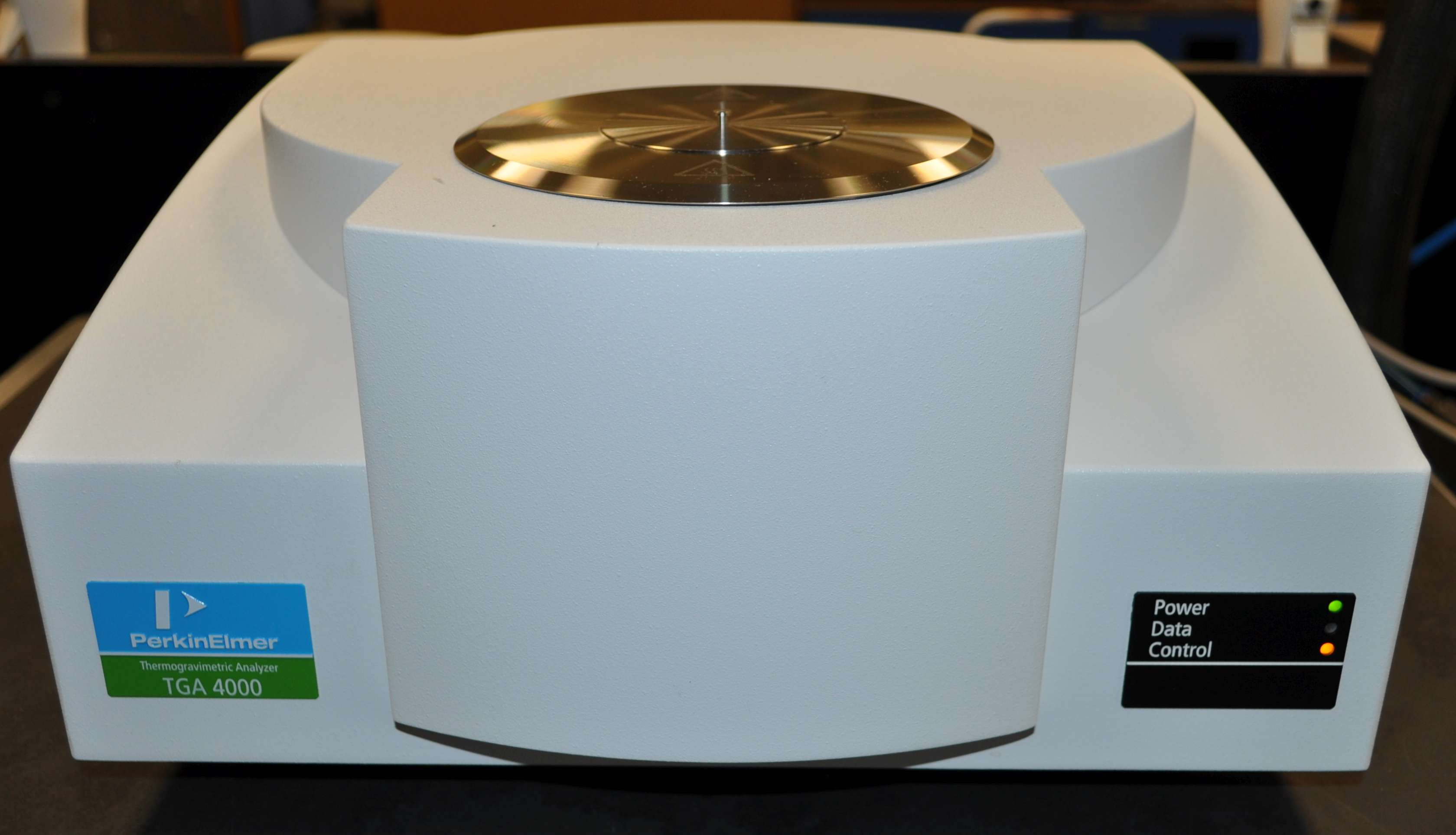
The laboratory’s TGA, which is a Perkin Elmer TGA4000, can be used to ramp temperatures between room temperature and 1000degC in different gas atmospheres such as air, nitrogen or inert gases.
 TGA analysis is employed in research, product development, failure analysis and testing to characterise materials such as inorganic compounds, monomers, polymers, rubbers , petrochemicals or organic compounds, breakdown products, to determine:-
- Degradation temperatures.
- Absorbed moisture content and volatiles in materials.
- Level of inorganic and organic components in materials.
- Decomposition points of chemicals and materials including explosives.
- Temperatures that solvent residues are driven off.
- Loss on Drying LOD and Loss on Ignition LOI measurements on small sample masses like gravimetric techniques.
The Thermogravimetric Analyser (TGA) is an essential laboratory tool used for material characterisation. TGA is used as a technique to characterise materials used in various environmental, pharmaceutical, polymers, GFRP and CFRP composite materials and petrochemical applications and is a powerful technique when used alongside other chemicals and materials analytical techniques such as DSC, FTIR, pyrolysis GC-MS, Headspace GC-MS and SEM / EDX on plastics and paint coatings for example.
Thermal Gravimetric Analysis Applications include:-
- Quality Assurance / Quality Control to ensure products meet their material specifications.
- Using TGA to ensure product safety.
- Determination of carbon content of a material or compound.
- Identify safe operating temperatures in various gases.
- Enhance product formulation processes.
- Determination of kinetic parameters, Arrhenius activation energy and pre-exponential factor of materials that obey first order kinetics.
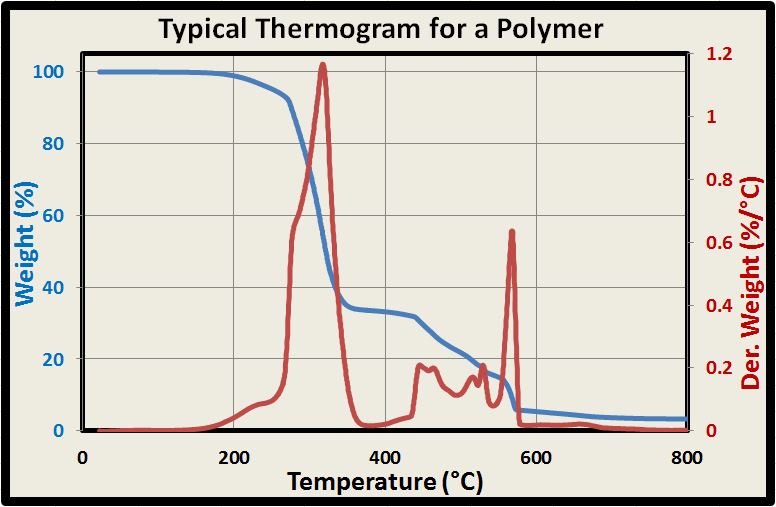
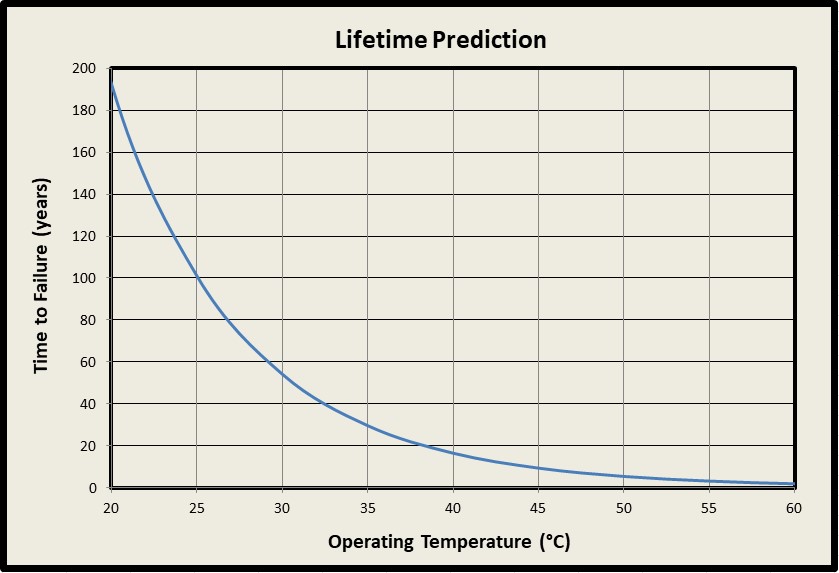
Plastics TGA Methods include:-
- Weight loss of plasticisers on heating.
- Thermal stability of PVC resin.
- Volatile Matter including water of Vinyl Chloride resins.
- Response of rigid cellular plastics to thermal and humid aging.
- Recommended practice for heat aging of plastics without load.
- Determination of carbon black content in polyethylene compounds by a muffle furnace.
- Test for carbon black in olefin plastics for heat aging of oxidatively degradable plastics.
- Compositional and formulation analysis by TGA.
- Decomposition kinetics by TGA.
The laboratory's TGA expert is Iola Main.