

AAS - Atomic Absorption Spectrophotometry
 Typical Applications of AAS - Atomic Absorption Spectrophotometry
- Quantitative metal concentrations in solution.s
- Analysis of Lead content in paint for risk assessment, removal and waste disposal.
- Monitoring of trace metals in industrial effluent streams.
- Trace elements in product / raw materials along with ICP-MS.
- Analysis of additives and purity in steels and other metal alloys.
- Analysis of low level contaminants.
Extensive wet preparation facilities are also available on site.
Application Notes
| Document Title | View |
| Waste Characterisation, Unknown Chemical Contamination and Lead in Paint Analysis |  |
Principle of AAS
AAS quantitatively measures the concentrations of elements present in a liquid sample. It utilises the principle that elements in the gas phase absorb light at very specific wavelengths which gives the technique excellent specificity and detection limits.
The sample may be an aqueous or organic solution, indeed it may even be solid provided it can be dissolved successfully. The liquid is drawn in to a flame where it is ionised in the gas phase.
Light of a specific wavelength appropriate to the element being analysed is shone through the flame, the absorption is proportional to the concentration of the element. Quantification is achieved by preparing standards of the element.
Features of the Laboratory’s AAS Capabilities
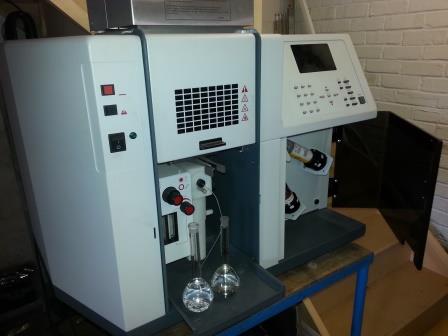
The lab has and Agilent - Varian SpectrAA 55b AAS instrument.
- Enables elemental analysis at percentage to parts per million (ppm) levels for a wide range of metals and some non-metals:
Elements available: Aluminium, Antimony, Arsenic, Barium, Beryllium, Bismuth, Boron, Cadmium, Calcium, Chromium, Cobalt, Copper, Dysprosium, Gold, Iron, Lead, Lithium, Magnesium, Manganese, Mercury, Molybdenum, Neodymium, Nickel, Palladium, Platinum, Potassium, Praseodymium, Rhodium, Silicon, Silver, Sodium, Strontium, Tellurium, Terbium, Thallium, Tin, Titanium, Tungsten, Vanadium, Zinc and Zirconium. (Other elements available on request).
Please contact us to discuss how your requirements can be met using this or any of our analytical techniques. We can issue no-obligation quotations once we have discussed your needs and can offer two levels of service “urgent” and “normal”. We also offer preferential rates for longer term analysis contracts. Click here to find out more.