

RoHS Compliance Screening
 LPD Lab Services offer an extended RoHS screening testing service. Both UK and EU RoHS regulations limit the amount of certain chemicals in the constituents of products, appliances and subcomponents. The limits apply to the following:
- Lead (Pb)
- Mercury (Hg)
- Cadmium (Cd)
- Hexavalent Chromium (Cr 6+)
- Polybrominated Biphenyls (PBBs)
- Polybrominated Diphenyl Ethers (PBDEs)
- Phthalates
In order to declare a product RoHS compliant the lab tests for the presence of certain elements and the levels of some of the above chemical species in the homogenous components of a product. Importantly the lab can perform an initial screening test in order to check if there are likely to be any significant levels of the named substances present.
For materials screening purposes combinations of XRF, FTIR, SEM / EDX, AAS and GC-MS methods can be used in order to ascertain if the product does contain regulated sunstances.
PBBs and PBDEs are used as fire retardants in many product types from polymers and films through to circuit boards and papers. The lab uses XRF calibrated for organic matrices to generally test for the level of bromine in a sample of material: If the level is high then further tests are conducted to ascertain if the bromine is in the PBB or PBDE form using GC-MS or other techniques.
Phthalates can also be investigated using GC-MS methods.
Chromium Six Cr(VI) is used in certain products, it is a potent carcinogen and hence is restricted by RoHS regulations. It can occur in paints, inks, coatings, plating, dyes, wood preservers, leather tanning solutions conversion coatings and steels.
SEM / EDX is used to check that lead free solders have been used in various soldered joints in PCBs.
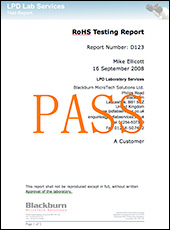
Once LPD Lab Services have analysed your product a test report is issued which meets the requirements of the RoHS standard to ensure you have proof that your products are compliant in order to complete the necessary declarations.
Please contact us to discuss your RoHS testing requirements.