

Metallurgical Failure Analysis
Metallurgical failure analysis is a core materials testing service at LPD Lab Services, an independent, UKAS-accredited analytical laboratory based in Blackburn, East Lancashire. Metallurgy is a term that covers a wide range of practices, from the extraction of metals from their ores and the refining of crude metals, to the production of alloys, their shaping and the manipulation of their properties. Metallography is a branch of metallurgy concerned with the examination and characterisation of the structure of metals and alloys. At LPD Lab Services, analysis, interpretation and consultancy of the metals data are carried out or overseen by the laboratory’s Senior Metallurgist Danie Els, who generates metallurgical failure analysis reports for clients across the UK.
Metallography: Microstructural Examination of Metals and Alloys
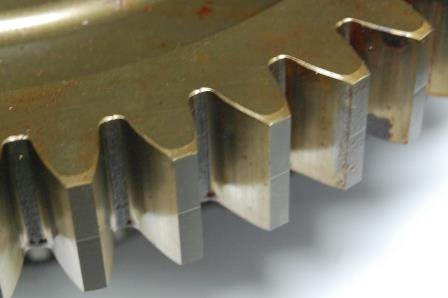
The mechanical properties of alloys are determined by both their chemical composition and their microstructure. Metallography identifies the microstructural phases present in a metal or alloy, estimates the volume fraction of each phase, assesses the grain size, and discovers defects or irregularities that may have contributed to poor performance or to a component failure.
Sample Preparation and Microscopy for Metallurgical Failure Analysis
To assess the microstructure of an alloy, a cross-section is systematically prepared by rough grinding, fine grinding, polishing and etching. Mounting in a resin is used for the preparation of small sections, and a non-destructive approach can be adopted by replicating the surface microstructure using an acetate sheet or a bespoke medium.
Examination is performed using binocular microscopes (5x to 25x magnification), light optical microscopes (50x to 1000x magnification), or scanning electron microscopes SEM / EDX (50x to more than 10000x magnification). Metallography is routinely used in quality control and is indispensable in conducting failure examinations and reverse engineering. Together with hardness testing and microhardness testing, metallography can indicate the effectiveness of thermal-mechanical treatment or welding processes and the accuracy of heat treatment processes.
Fractography: Fracture Surface Analysis for Root Cause Investigation
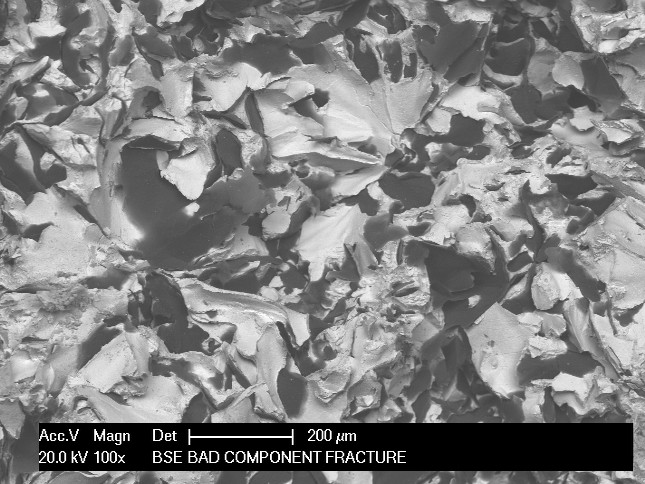
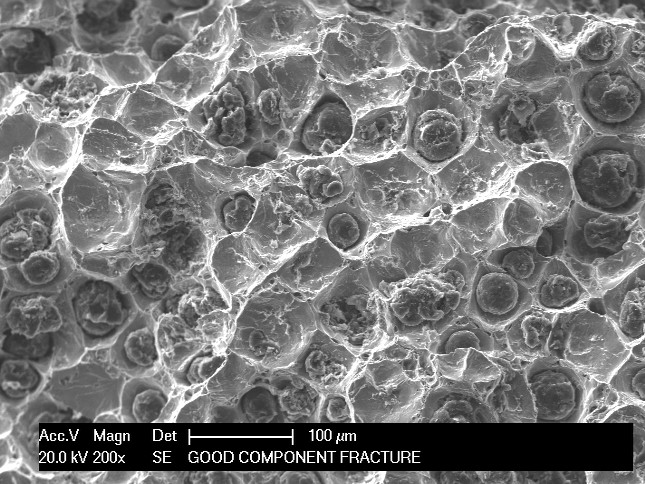
Fractography is the study of the characteristic features on fracture surfaces, used to determine the nature of a fracture and to identify the fracture initiation point. It is applied to metals and non-metallic materials, and fractographic analysis is the first step in analysing the root cause of a failure. The investigation begins with visual examination, followed by low-power magnification, typically using a binocular microscope.
Scanning electron microscopy (SEM) can also be applied to aid fractography at a finer scale, characterising flaws such as stress concentrators, inclusions or porosity. EDX in the SEM allows the composition of any inclusions to be determined at the initiation site, for example, giving a clear indication of what triggered the fracture.
Advanced Techniques in Metallurgical Failure Analysis
LPD Lab Services applies metallography and fractography along with other advanced analytical techniques such as Electron Backscatter Diffraction (EBSD) and 3D X-ray imaging to assist in failure and root cause analysis as well as product and process development. These complementary techniques extend the metallurgical investigation beyond the fracture surface, supporting failure and root cause analysis as well as product and process development.
Typical Applications of Metallurgical Failure Analysis
Metallurgical failure analysis and metallographic examination are applied across a wide range of industrial problems, including:
- Engine component failure analysis and internal corrosion.
- Bearing failure investigation.
- Tool failure and wood drill metallurgical failure investigation.
- Weld assessment and failure investigation, weld inclusions and determination of size of heat affected zone HAZ.
- Detecting Residual Stress and SCC testing in Copper Alloys – Brass, Bronze and Cupronickel.
- Cutting Tool Failure and Jigsaw Blade Metallurgical Failure Investigation.
- Checking for grades of cast iron - spheroidal, grey and white cast irons.
- LECO carbon and sulphur IR analysis in metals and alloys like steels, nickel and cobalt superalloys, brass bronze and copper alloys.
- Cleaning and degreasing of metals.
- Microstructure and grain size assessment.
- Corrosion and high temperature oxidation of metals.
- Heat treatment and surface treatment of metal components including nitride hard coatings on steel assessed by microhardness measurements.
- Powder metallurgy and failure investigation including sintering and green cracking problems.
- Surface preparation, chemical etching, electrochemical and pickling processes.
- Anodising of aluminium alloys and castings for painting or adhesive bonding.
- Hardness and friction and wear.
- Alloy and metal component analysis.
- Landfill gas engine and power generation system failure investigations.
- Plating blistering and uniformity using cross-sectional analysis.
- Confirmation of raw material structure and composition.
- Parts comparison for engine production and alternative supplier evaluation.
- Root-cause for overload failure in cast metal components.
- Metal fragment and foreign particle identification and analysis.
- Assessment of structural changes in heat treated steel.
- Impurity analysis in various metals using ICP-OES.
- Steam boiler tube failure examination including water wall, superheater and reheater.
- Coatings and layer measurement.
Example Metallurgical Failure Analysis Reports
- Example Metallurgy, Failure Analysis and Consultancy report
- Example Cutting Tool Failure and Jigsaw Blade Metallurgical Failure Investigation report
- Example Metallurgical Examination of a Failed Automotive Helical Suspension Spring report
Frequently Asked Questions About Metallurgical Failure Analysis
What is metallurgical failure analysis?
Metallurgical failure analysis is the investigation of why a metal or alloy component has failed, using metallography and fractography to examine the microstructure and the fracture surfaces. At LPD Lab Services in Blackburn, East Lancashire, each investigation is carried out or overseen by our Senior Metallurgist and concludes with a metallurgical failure analysis report.
How is metallography carried out on a failed component?
A cross-section of the component is systematically prepared by rough grinding, fine grinding, polishing and etching; small sections are mounted in a resin, and a non-destructive replica can be taken on an acetate sheet or a bespoke medium. The section is then examined using binocular microscopes (5x to 25x), light optical microscopes (50x to 1000x) or a scanning electron microscope with EDX (50x to more than 10000x).
What is fractography and how does it identify the cause of a fracture?
Fractography studies the characteristic features on fracture surfaces to determine the nature of the fracture and locate the fracture initiation point. The examination begins visually, then at low-power magnification, and at finer scales with the SEM; EDX in the SEM can determine the composition of inclusions at the initiation site.
Which materials and failure problems can you investigate?
We investigate metals and non-metallic materials, including steels, spheroidal, grey and white cast irons, copper alloys such as brass, bronze and cupronickel, aluminium alloys and nickel and cobalt superalloys. Typical work covers bearing, tool, weld and spring failures, castings, powder metallurgy, coatings, corrosion and heat treatment, supported by hardness testing, SEM/EDX, EBSD, 3D X-ray imaging and LECO carbon and sulphur analysis.
Request a Quote for Metallurgical Failure Analysis
Whether you need a metallographic examination, fractography of a fracture surface, or a full metallurgical failure analysis with a written report, our metallurgists in Blackburn, East Lancashire are ready to help. As an independent, UKAS-accredited laboratory serving clients across the UK, we combine rigorous analysis with practical, cost-effective recommendations. Discuss your component failure with our metallurgy consultancy team and request a quote today.