
Mechanical Testing
 Principle of Mechanical or Tensile Testing
A materials test subjecting a specimen of a material or component to a mechanical force, either:-
- Tensile or pulling
- Compressive or crushing
- Bending and flexing
- Torsion or twisting
- Frictional and dragging
- Peel resistance
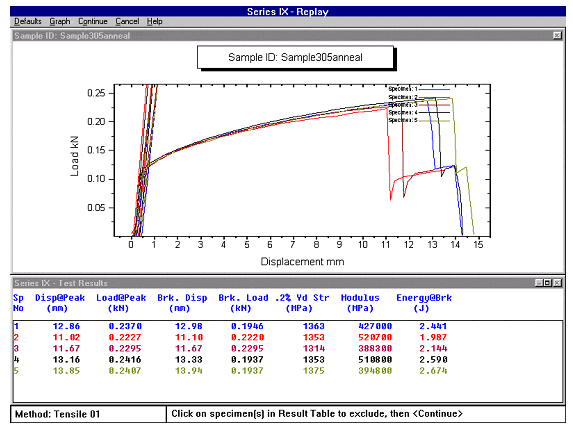
The testing machine automatically measures the forces applied and the resulting behaviour of the material. Mechanical properties can be derived from the Load / displacement or Stress / Strain curves:-
- Yield Strength / Yield Point (YS)
- Ultimate Tensile Strength (UTS)
- Youngs Modulus for elasticity
- Modulus of Toughness - Brittleness
- Elongation and reduction in area - Ductility
Main Features of Laboratory’s Tensile Testing Capabilities
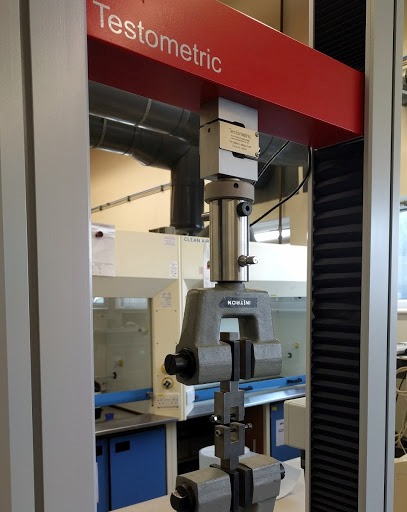
Instrument - Testometric M500-50CT tensile test machine
- Load cells of 50N, 2.5kN, 50kN
- System has software for the automatic collection and display of stress/strain data, with facilities for post processing and the replay of tensile tests. The software allows methods to be set up and stored for instant recall. Using the software it is possible to rerun a sample using a new set of data analysis parameters. The instrument can apply loads up to 50kN, at a variety of crosshead speeds to accommodate the fact that different loading rates can affect the measured mechanical properties.
Typical Applications of Tensile Testing
Suitable for the mechanical testing of
- Plastics
- Rubbers
- Metals
- Engineering Ceramics
- Composite Materials (fibre glass or carbon fibre reinforced plastics)
- Parts, components tubes and wires
- Friction measurements.
Our site experts on Tensile Testing are Wyndham Johnstone and Danie Els.
No documents matching criteria